




Đội ngũ của chúng tôi có hơn 7,000,000 thương nhân!
Hàng ngày chúng tôi làm việc cùng nhau để cải thiện việc giao dịch. Chúng tôi nhận được kết quả cao và luôn tiến lên phía trước.
Sự công nhận của hàng triệu thương nhân trên toàn thế giới là sự đánh giá tốt nhất cho công việc của chúng tôi! Bạn đã đưa ra quyết định của mình và chúng tôi sẽ làm mọi thứ cần thiết để đáp ứng mong đợi của bạn!
Chúng ta cùng với nhau sẽ là một nhóm tuyệt vời!
InstaSpot. Tự hào làm việc cho bạn!





Diễn viên, nhà vô địch mùa giải UFC 6 và là người hùng thật sự!
Người tự mình làm nên tất cả. Người đàn ông đáng kể học hỏi.
Bí mật đằng sau thành công của Taktarov là sự cố gắng liên tục hướng tới mục tiêu.
Hãy khai phá tất cả các mặt tài năng của bạn!
Khám phá, thử, thất bại - nhưng không bao giờ dừng lại!
InstaSpot. Câu chuyện thành công của bạn bắt đầu từ đây!
Today Brent fell to $101 per barrel, while WTI trades around $90. Saudi Aramco's decision to price Arab Light $5 below the regional benchmark for Asian buyers in October triggered the decline. The market had expected the opposite — traders and refiners were preparing for a $5 premium. Asian refineries and fuel consumers benefit. Saudi Arabia loses revenue per barrel but protects market share. However, intensifying fighting in Yemen partially offset the decline.
The scale of the reversal is visible in comparison. Relative to market expectations, the price shifted by $10. If you take April, when in the first weeks of the war Aramco set a record premium of $19.50 for Asia, then from that level to the current discount is $24.50. The current decision recognizes the obvious: there is more oil in the system than feared, and the kingdom prefers to keep Asian customers rather than squeeze maximum revenue from a shortage.
Compared with mid-September, the drop looks notable. Brent closed around $107.63 on September 11, so the fall is roughly 6% from that level, and about 20% from the April wartime peak of $126. WTI looks sharper: it closed at $102.48 on September 11 and is now near $90, down about 12%. The spread between the two grades has widened from just over $5 to roughly $11. It is telling that the US benchmark is falling faster: it is more tied to domestic inventories, while the global market continues to price a shipping-risk premium.
Physical supply is indeed improving. Oil flows have recovered toward pre-war levels in recent weeks, although refined-product deliveries remain constrained. Recall that on September 11 the Dated Brent physical premium over futures exceeded $12, and diesel margins in the US hit a record. To knock down prices, the G7 and its partners announced an additional release of emergency stocks last week.
But, as noted above, the other side of the equation is Yemen. The Riyadh-backed government has launched a full-scale operation to retake all areas controlled by the Houthis, who Iran supports. The group is fighting internal rivals and striking Saudi energy infrastructure. Military experts note the decisive factor will be control of the country's west coast toward the Bab el-Mandeb strait.
Risks on the water also remain. The UK Maritime Trade Operations (UKMTO) reported an incident in the Strait of Hormuz on October 4, and recorded a separate incident off Mocha in the Red Sea. Against that backdrop, OPEC+'s decision by the major participants to keep November production quotas unchanged changes almost nothing.
For macroeconomics, this is the main channel: oil, then inflation, then rates. Expensive energy pushed eurozone inflation to 3.8% in September, with energy contributing 18.8% y/y, and US August CPI was 3.4%, with gasoline accounting for one-third of the monthly gain. So a sluggish oil market alters central-bank arithmetic. The market now prices in under a 20% chance of a Federal Reserve hike in October, and cheaper oil reinforces that expectation.
The question is whether the market is ready to break $100 and hold below it. Not yet. Oil is hovering around that level because two factors balance each other: rising supply presses prices down, while shipping risks and the Yemen campaign provide support. In my view the next sessions will have a downward bias, and Brent will likely test $98–$99 if product flows continue to recover and G7 emergency stocks begin to hit the market. But any serious incident in Hormuz, off Mocha, or on Saudi infrastructure would push the price back above $105 within hours.
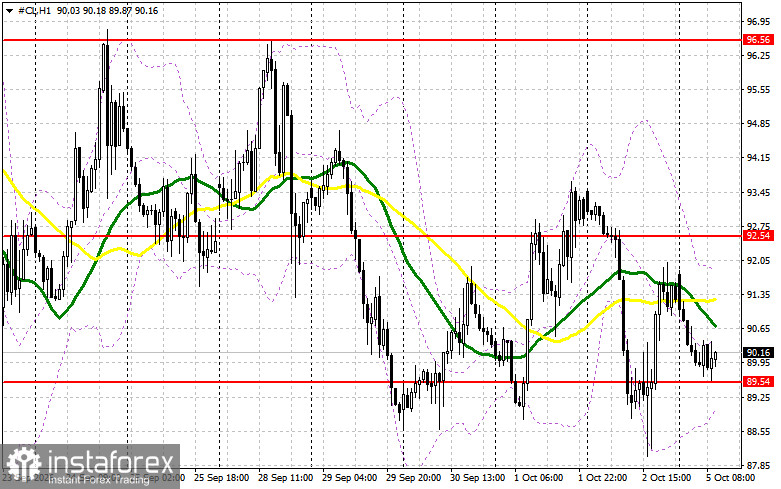
Regarding the current technical picture for oil, buyers need to take the nearest resistance at $92. That would allow a target of $96, above which a breakout will be difficult. The farthest target is the $100 area. If oil falls, bears will try to seize $89. If they succeed, a range break would seriously hurt bulls and drive oil down to $87 with a prospect of reaching $83.
*Phân tích thị trường được đăng tải ở đây có nghĩa là để gia tăng nhận thức của bạn, nhưng không đưa ra các chỉ dẫn để thực hiện một giao dịch.
InstaSpot analytical reviews will make you fully aware of market trends! Being an InstaSpot client, you are provided with a large number of free services for efficient trading.


