




The euro opened the morning with a strong inflation reading but still failed to move higher, while the pound had no domestic news and moved in line with the dollar. The dollar itself remained range-bound as the market awaited the US employment report. As a result, both pairs are trading within a narrow range between the breakout levels, and neither side has yet been willing to make a significant move.

The main news for the euro was the preliminary September inflation estimate for the euro area, released this morning. Headline consumer price inflation rose to 3.8% year-on-year, compared with 3.3% in August. It answers a simple question: how much more expensive has the usual basket of goods and services become over the past year? The higher the figure, the more inclined the central bank is toward a tighter policy stance. The currency, however, reacted only modestly. The market has already priced in the ECB's September deposit rate hike to 2.50%, so traders are concerned not with the acceleration itself, but with how much further the regulator is prepared to go.
The acceleration was driven primarily by energy prices, which rose by almost 19% year-on-year, compared with 14.3% a month earlier. Oil and petroleum products remain expensive because of the war involving Iran and tensions around the Strait of Hormuz. Gas is adding to Europe's problems, as storage levels are lower than in any autumn since 2009. More concerning is the increase in the prices of services and food, because such prices tend to remain elevated longer than commodity price spikes. Industrial goods, by contrast, have slowed, so it is still too early to speak of broad-based price increases, but secondary effects are gaining strength.
The picture for the euro is mixed. The policy rate is significantly below inflation, arguments for a pause are weakening, and expectations for October therefore continue to favor another rate hike, which remains the main scenario. On the other hand, weak demand, high gas prices, and more expensive energy imports are weighing on the region's economy and preventing the currency from gaining strong upward momentum. Declines in the euro are likely to be bought, but a sharp upward move is not expected.
There are no UK economic data releases today. The calendar contains neither inflation, labor market, nor business activity data, while such releases usually provide guidance on the Bank of England's interest-rate outlook and shape sentiment toward the pound. Without them, GBP/USD loses some of its independence and becomes largely a reflection of the US currency. In addition, the British currency remains vulnerable because of the budget situation. The government bond market is nervous, and the country's borrowing remains near multi-year highs, so strong demand for the pound is not evident.
The main event of the week after midday will be the September US labor market report, which will largely determine how the euro and pound behave through the end of the trading session. The market is watching four things: the change in nonfarm employment, unemployment, hourly earnings growth, and private-sector employment. The first figure is the most closely watched, with 90,000 new jobs expected for the month. Wages are important because rapidly rising incomes push prices higher and force the central bank to keep interest rates high. The forecast is relatively low, but August showed an increase of 162,000 compared with a forecast of 55,000. Therefore, each new report is now being viewed as a test of whether the August figure was an isolated result or the beginning of a sustained shift.
If employment growth is significantly above forecast, the dollar will receive support and there will be more arguments for a hawkish Fed stance. In that case, the euro and pound will have little reason to rise. The euro would appear more resilient in such a situation, as the ECB has already raised rates and an October hike remains on the table. The pound is more vulnerable because budget uncertainty adds to external pressure, making further dollar strength more difficult for the currency to absorb. The opposite scenario appears more favorable. If employment growth is much weaker and wage growth slows, the dollar and US yields could retreat, significantly increasing the chances of an upward correction in both pairs. Until the end of the day, this report will remain the main market reference point, and before its release the market is unlikely to open large positions.
Momentum
The strategy here is based on breakouts: an entry is made when the price moves beyond a level and consolidates beyond it.
For the euro, the upside reference level is 1.1264. If the pair breaks above it and holds there, the first target is 1.1307 and the second is 1.1346. This move appears realistic mainly if the US data are weak, as the morning's euro-area inflation data failed to provide upward momentum. The downside breakout level is 1.1218, followed by targets at 1.1174 and 1.1136. This scenario would be triggered by strong employment data and a stronger dollar, and after the August surprise it cannot be ruled out. There are only 46 points between the two levels, meaning that the pair is likely to move within this range before the report is released. Therefore, trading touches of these levels before the release does not appear justified. The upside scenario appears slightly more likely, but the report itself will determine the outcome.
For the pound, buying opportunities are considered above 1.3223, with targets at 1.3265 and 1.3307, while selling opportunities are considered below 1.3180, with targets at 1.3137 and 1.3097. The range between the two levels is 43 points. The pound has no domestic news today, so it will follow the dollar, and the key question is where the US currency moves after the data. With a strong report, a downward breakout appears more natural for the pound than for the euro, as the budget issue leaves the currency with less room for resilience. With a weak report, the pound could reach 1.3265, but maintaining that advance would be more difficult. Therefore, it would be prudent not to be overly ambitious at the first target.
Mean Reversion
In this section, the focus is on a false breakout beyond a boundary followed by a quick return inside the range.
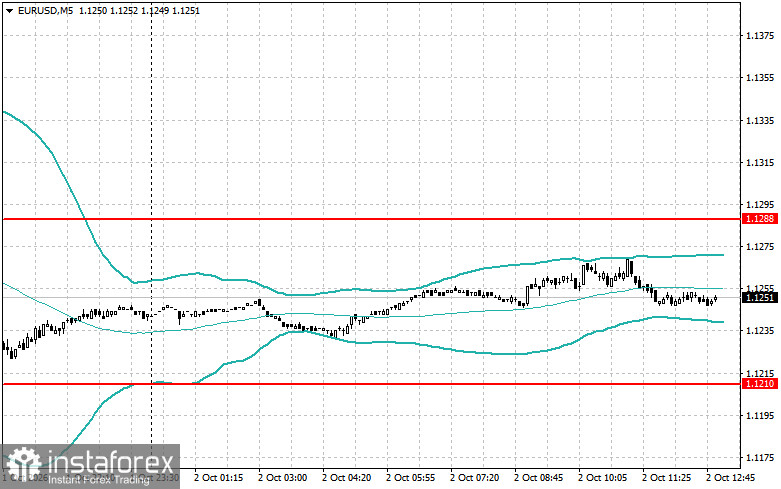
For the euro, the upper reference level of 1.1288 is 24 points above the breakout level of 1.1264 and lies directly on the way to the first target at 1.1307. This leads to a simple conclusion. If the price breaks above 1.1264 and consolidates there, then 1.1288 is merely an intermediate level on the way higher, and selling there would not be appropriate. If, however, the pair moves above the level, fails to hold there, and returns below 1.1264, selling opportunities can be considered, with a stop above the recent high. The lower reference level of 1.1210 is only 8 points below the breakout level of 1.1218, so beginners need to exercise particular caution here. The difference between a breakout and a false breakout can occur within a matter of minutes, so the first test of the level should be ignored until the outcome of the attempt becomes clear. If the price moves below 1.1210, fails to continue lower, and returns above 1.1218, this would provide a basis for buying. Such reversals most often occur when the report is close to expectations and the market, after initially reacting to the figure, begins to reverse that move.
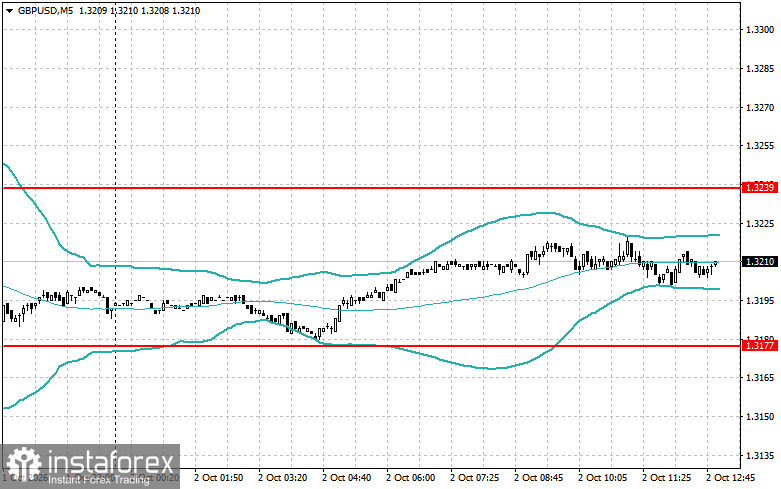
For the pound, the upper reference level of 1.3239 is 16 points above the breakout level of 1.3223 and also lies on the way to the first target at 1.3265. Here, the focus is on a move above the level, failure to consolidate there, and a return below 1.3223. Only after such a return would selling opportunities be considered, with the stop placed above the high of the failed attempt. If the price holds firmly above 1.3223, then 1.3239 is merely an intermediate level and the move should be treated as a breakout. The lower reference level of 1.3177 is the most difficult of all, as it is only three points away from the breakout level of 1.3180. Such a narrow gap is smaller than normal market noise, making it impossible to distinguish a breakout from a false breakout based on a single test. If the price moves below 1.3177 and consolidates there, it is a breakout, and buying should be avoided. If it briefly declines below the level and quickly returns above 1.3180, this constitutes a reversal, and buying opportunities can be considered with a stop below the low of the false breakout. For the pound, which has no domestic news, this scenario is particularly relevant if the US report comes in around 90,000. The initial reaction may send the pair sharply in one direction, after which a reversal could bring it back into its usual range.
*Phân tích thị trường được đăng tải ở đây có nghĩa là để gia tăng nhận thức của bạn, nhưng không đưa ra các chỉ dẫn để thực hiện một giao dịch.
InstaSpot analytical reviews will make you fully aware of market trends! Being an InstaSpot client, you are provided with a large number of free services for efficient trading.