




Ons team heeft meer dan 7,000,000 handelaren!
Elke dag werken we samen om de handel te verbeteren. We behalen hoge resultaten en gaan verder.
Erkenning door miljoenen handelaren over de hele wereld is de beste waardering voor ons werk! U heeft uw keuze gemaakt en wij zullen er alles aan doen om aan uw verwachtingen te voldoen!
Wij zijn samen een geweldig team!
InstaSpot. Trots om voor je te werken!





Acteur, UFC 6-toernooikampioen en een echte held!
De man die zichzelf heeft gemaakt. De man die onze kant op gaat.
Het geheim achter het succes van Taktarov is een constante beweging naar het doel.
Onthul alle kanten van je talent!
Ontdekken, proberen, falen - maar nooit stoppen!
InstaSpot. Je succesverhaal begint hier!

The EUR/USD pair remains within a weak corrective pullback, which cannot yet be considered complete. Last week saw a number of important events, but I cannot say they significantly influenced trader sentiment or the movement of EUR/USD. Perhaps the key takeaway from last week's news flow is the European Central Bank's willingness to raise interest rates if inflation continues to accelerate, contrasted with the FOMC's reluctance to take similar measures. Thus, bulls have received another supporting factor, of which they already have no shortage. However, on Monday, bulls were in no rush to launch a new attack. Around midday, it became known that Iran had attacked a U.S. destroyer in the Persian Gulf near the Strait of Hormuz. Official Washington quickly stated that the ship had not been sunk, and where the missiles hit—or whether they hit the U.S. Navy vessel at all—remains unclear. It is quite possible that Tehran launched warning missiles that landed somewhere near the destroyer, or that they were low-power missiles causing minimal damage. Nevertheless, it must be noted that the situation is clearly not moving along a peaceful path. The dollar showed slight growth on Monday, but a full escalation did not occur—and that is a positive development.
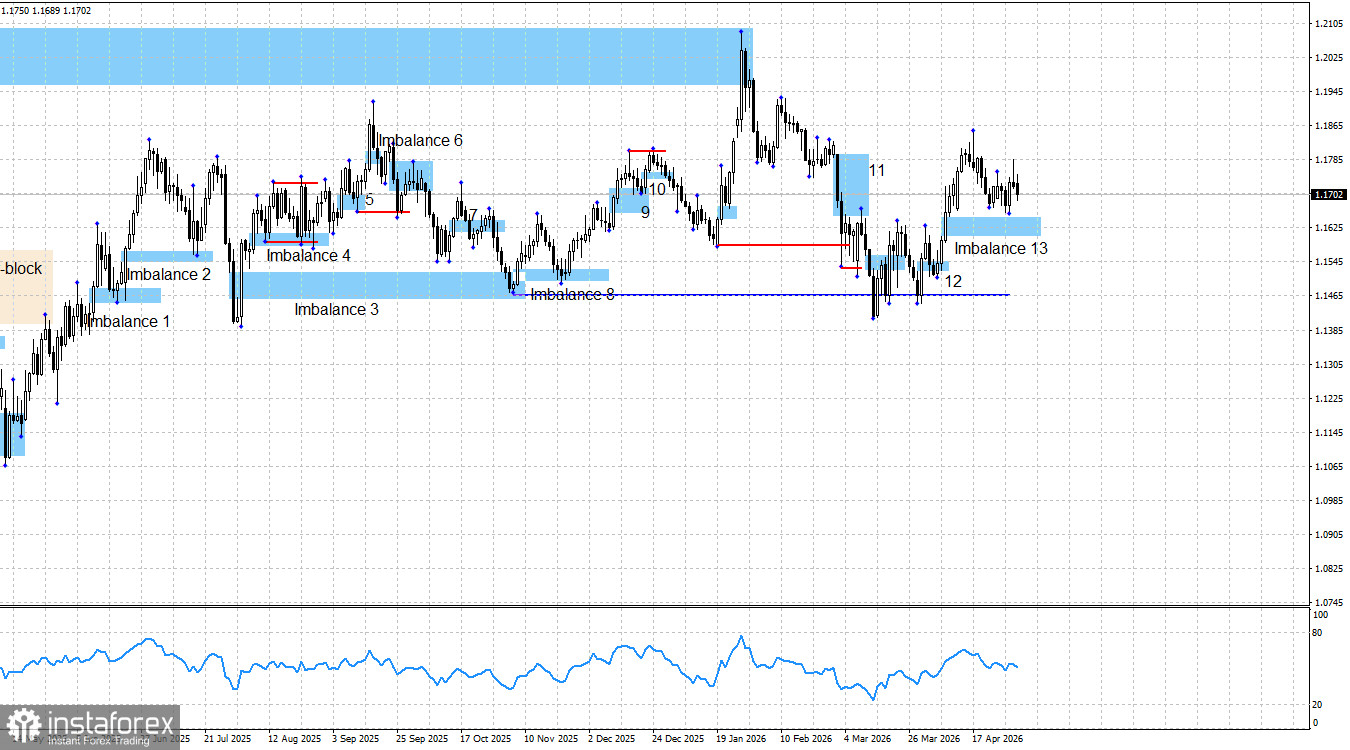
In the current situation, traders can only wait for the resolution of imbalance 13 or the formation of new bullish patterns. I continue to consider the trend "bullish." Last week, bulls fell just short of resolving imbalance 13 and generating a signal. There are no bearish patterns at the moment, so there is no clear basis for selling the pair. The previous buy signal from imbalance 12 worked perfectly, with the euro gaining approximately 270 points.
It is also worth noting that the entire rise of the U.S. dollar from January to March was driven solely by geopolitics. As soon as the U.S. and Iran agreed to a ceasefire, bears immediately retreated, and bulls launched an offensive. At present, the truce is quite fragile but still holding. I have repeatedly stated that I do not believe the bullish trend has ended, despite the break of important trend-forming lows. The price movement over the past two months could turn into a bearish trend if geopolitical conditions continue to deteriorate. However, markets often price in the most pessimistic scenario, trying to anticipate the most extreme developments. Therefore, it is possible that traders have already fully priced in the geopolitical conflict in the Middle East. For further bullish attacks, there is currently a lack of positive factors, while bears lack sufficient negative catalysts.
The overall chart picture is currently clear. The bullish advance remains intact but requires support. This week, support may come from U.S. labor market data, unemployment figures, job openings, ISM business activity reports, as well as geopolitical developments. As we can see, Monday did not start calmly, but I would not yet speak of a full-scale escalation in the Middle East.
The information background on Monday was absent (apart from geopolitics). ECB President Christine Lagarde is scheduled to speak in the evening, but I do not expect significant statements regarding monetary policy. The ECB meeting took place last week, and traders already understand the regulator's stance for the coming months. Everything will depend on energy prices and inflation.
Bulls still have plenty of reasons to push higher in 2026, and even the outbreak of war in the Middle East has not reduced them. Structurally and globally, Trump's policy—which led to a significant decline in the dollar last year—has not changed. In the coming months, the U.S. currency may occasionally strengthen amid risk aversion, but this requires ongoing escalation in the Middle East. I still do not believe in a bearish trend. The dollar has received temporary market support, but what will sustain a long-term bearish move?
News calendar for the U.S. and the Eurozone:
On May 5, the economic calendar contains four entries, two of which are of interest. The impact of the news background on market sentiment on Tuesday may be felt in the second half of the day.
EUR/USD forecast and trader advice:
In my opinion, the pair remains in the formation stage of a bullish trend. The information backdrop changed sharply two months ago, but the trend cannot be considered canceled or completed. Therefore, in the near future, bulls may well continue their advance if geopolitics does not sharply turn toward a new escalation.
Traders had the opportunity to open buy positions based on the signal from imbalance 12, and the upward movement may continue toward the yearly highs. Imbalance 13 has also formed and may generate a bullish signal in the near future. For the euro to grow without obstacles, the Middle East conflict must move toward a stable peace—something that is not currently observed. Bulls currently lack sufficient support but may gain it during the week.
*The market analysis posted here is meant to increase your awareness, but not to give instructions to make a trade.
InstaSpot analytical reviews will make you fully aware of market trends! Being an InstaSpot client, you are provided with a large number of free services for efficient trading.


