




The legend in the InstaSpot team!
Legend! You think that's bombastic rhetoric? But how should we call a man, who became the first Asian to win the junior world chess championship at 18 and who became the first Indian Grandmaster at 19? That was the start of a hard path to the World Champion title for Viswanathan Anand, the man who became a part of history of chess forever. Now one more legend in the InstaSpot team!





Borussia is one of the most titled football clubs in Germany, which has repeatedly proved to fans: the spirit of competition and leadership will certainly lead to success. Trade in the same way that sports professionals play the game: confidently and actively. Keep a "pass" from Borussia FC and be in the lead with InstaSpot!

Recent statements by Donald Trump about the war in Iran increasingly bring to mind Orwellian "doublethink," where mutually contradictory ideas can not only coexist, but be presented as simultaneous truth. In his remarks he increasingly combines incompatible and contradictory theses. For example, while saying that diplomacy is progressing great and success accumulates by the hour, he at the same time threatens to completely destroy Iran's critical infrastructure.
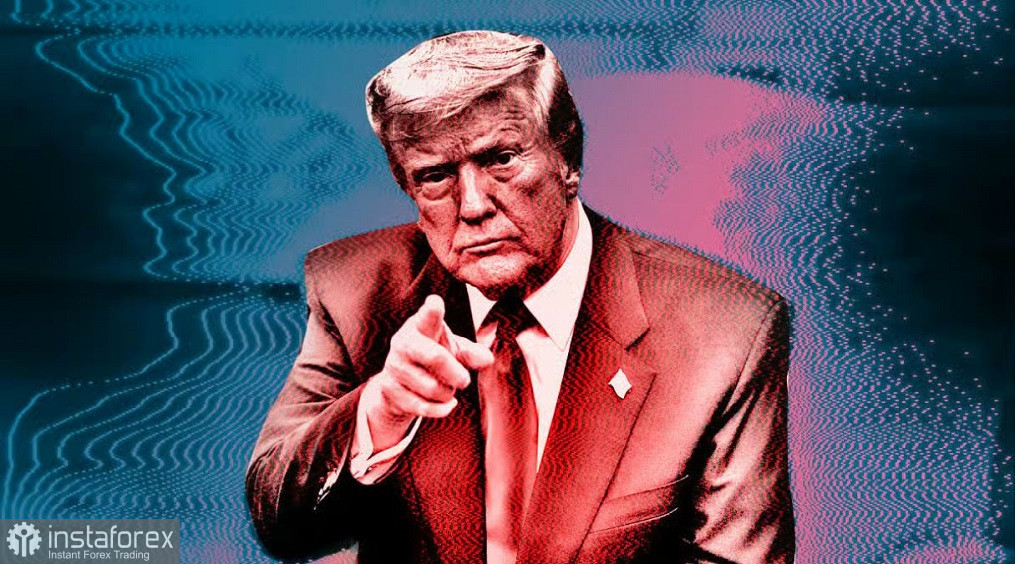
Such contradictory statements confuse market participants: it is becoming more and more difficult to find logical continuity in them to build any stable scenarios. The value of hard facts has declined, fundamental risk assessment has slipped into the background, while the role of market interpretation has grown. EUR/USD dynamics are increasingly determined, not so much by facts, as by which of Trump's mutually exclusive verbal lines the market decides to treat as the baseline at a given moment.
For example, over two days — Tuesday and Wednesday — the pair rose actively, gaining almost 200 pips (from 1.1448 to 1.1628). Traders were pricing in Trump's "peaceful" rhetoric, after he suggested that the US military campaign in the Middle East would end within the next two weeks, because US forces had completed all assigned tasks. Reacting to those words, EUR/USD traders actively opened long positions amid a renewed appetite for risk.
However, yesterday Donald Trump, in his address to the nation, again changed the tone of his rhetoric, switching mercy for wrath. He said that the United States would deliver an extremely strong strike to Iran within the next two to three weeks, returning that country to the stone age. Such an unexpected turn boosted the safe-haven dollar and, accordingly, EUR/USD sellers, who were able to organize a counteroffensive. As a result, the pair returned to the base of the 1.15 area, where it has since been drifting.
As for the fate of the Strait of Hormuz, the president of the US also sends contradictory signals (here we again return to Orwellian "doublethink"). On one hand, Trump states directly that the US does not need the strait, and that the countries dependent on this route must themselves ensure its security. On the other hand, Trump continues to insist on an ultimatum, threatening Iran with total destruction of infrastructure if shipping is not restored.
The difficulty of the situation is that the White House chief issues mutually exclusive messages within a single day, thereby blurring benchmarks for forming medium-term expectations. The market is forced to react to Trump's rhetoric in the moment, while simultaneously taking into account that in a few hours he may voice opposite signals.
In my view, one can speak of real signs of de-escalation only when the Iranian side itself talks about prospects for a deal. To date, Tehran is broadcasting opposite signals. First, Iran's Foreign Ministry denies that any negotiations are taking place. Second, the Iranians reject the demands put forward by the US. Foreign Ministry representatives acknowledge that they received terms for ending the war from intermediaries, but say those terms were excessively harsh and illogical.
In other words, the scales have again tipped toward an escalation scenario — there are no signs of a deal, nor signs of winding down the military operation in the Middle East.
The dollar also received additional support from the ISM manufacturing index, whose March value we learned during the US session on Wednesday. This key macro indicator not only remained in expansion territory but showed upward dynamics. Contrary to forecasts of a drop to 52.3, it rose to 52.7, thereby updating a multi-year high (the highest reading since August 2022). The index has been above the 50-point threshold for three months in a row. The market, however, ignored some "flaws" in the release. For example, the new orders subindex, although still in expansion at 53.5, was below forecast and prior readings, which points to a gradual weakening of external demand. In addition, despite manufacturing expansion, the employment subindex remained in contraction, falling to 48.7. This indicates job losses in the manufacturing sector.
But none of these nuances deterred market participants, given the confident rise in the headline measure.
Thus, the EUR/USD situation is ambiguous, largely due to Donald Trump's contradictory statements. Summing up his rhetoric and the official stance of the Iranian side, one can assume that the Middle East conflict is still far from over. That means the safe-haven dollar will continue to enjoy elevated demand. At the same time, it is worth noting that despite the downward impulse, EUR/USD sellers failed to leave the 1.15 area, stalling at 1.1516. This indicates that traders keep in mind Trump's unpredictability, since after yesterday's harsh speech he could, today, announce readiness for a deal with Tehran. Under these circumstances, corrective pullbacks should be used as opportunities to open short positions, but with a nearby target of 1.1510.
*The market analysis posted here is meant to increase your awareness, but not to give instructions to make a trade.
InstaSpot analytical reviews will make you fully aware of market trends! Being an InstaSpot client, you are provided with a large number of free services for efficient trading.


