




InstaSpot टीम में लीजेंड!
लीजेंड! आपको लगता है कि धमाकेदार बयानबाजी है? लेकिन हमें एक आदमी को कैसे बुलाना चाहिए, जो 18 साल की जूनियर विश्व शतरंज चैंपियनशिप जीतने वाला पहला एशियाई बना और 19 में पहला भारतीय ग्रैंडमास्टर कौन बना? यह विश्वनाथन आनंद के लिए विश्व चैंपियन खिताब के लिए एक कठिन मार्ग की शुरुआत थी, जो उस व्यक्ति के लिए हमेशा के लिए शतरंज का इतिहास बन गया। अब InstaSpot टीम में एक और लीजेंड!





बोरूसिया जर्मनी में सबसे अधिक शीर्षक वाले फुटबॉल क्लबों में से एक है, जो प्रशंसकों के लिए बार-बार साबित हुआ है: प्रतियोगिता और नेतृत्व की भावना निश्चित रूप से सफलता की ओर ले जाएगी। उसी तरह से व्यापार जिसमें खेल पेशेवर खेल खेलते हैं: आत्मविश्वास से और सक्रिय रूप से। बोरूसिया FC से एक "पास" रखें और InstaSpot के साथ नेतृत्व में रहें!

The EUR/USD pair continues to trade within a corrective pullback on Monday. I wouldn't say the market is moving in a predictable manner today, as it became known earlier this morning that the second round of negotiations between Iran and the United States had been canceled. Tehran stated that the U.S. blockade of the Strait of Hormuz and Iranian ports remains in place, and that the U.S. has seized an Iranian commercial vessel attempting to pass through the strait. According to Iranian authorities, these developments make it impossible to continue negotiations with Washington. It is worth recalling that the two-week truce expires on Wednesday, April 22, so at this point it appears that hostilities may resume after the pause. Donald Trump has already promised to destroy all power plants and bridges in Iran, and negotiations may now be delayed indefinitely. Bears have not yet launched a new offensive, as the truce still formally holds, and the situation could change several times before Wednesday. It would be premature to draw conclusions.
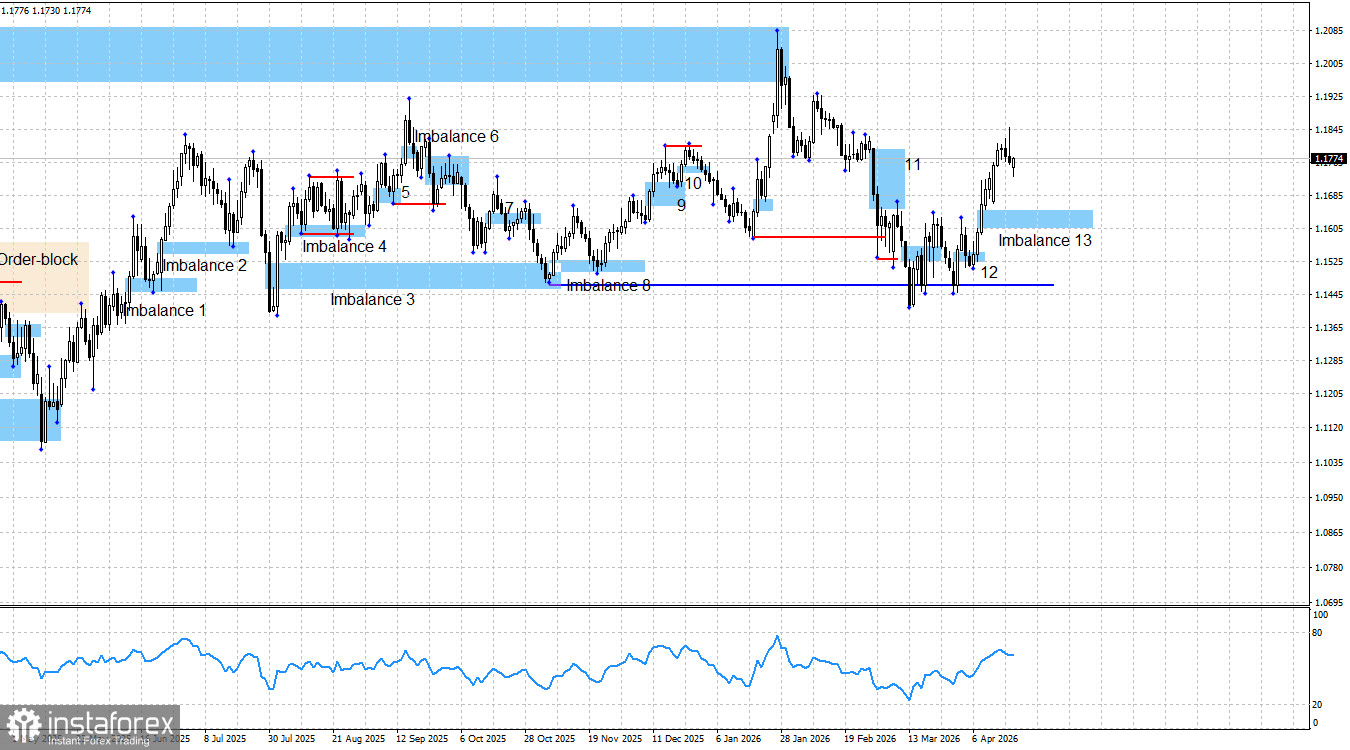
Last week, a reaction was observed at bullish imbalance 12, which triggered the advance of buyers. Thus, traders had the opportunity to open long positions, which are now in solid profit. At this point, traders can decide whether to lock in profits or wait for further upside. Partial profit-taking is also an option. The geopolitical backdrop is currently more favorable than it was two weeks ago, which likely explains the sharp improvement in bullish sentiment. However, sentiment could soon shift in favor of the bears. From a technical perspective, no bearish signals or patterns have formed, so I am not currently expecting a decline in the euro.
It is worth noting that the entire strengthening of the U.S. dollar over the past one and a half to two months has been driven solely by geopolitics. As soon as the U.S. and Iran agreed to a two-week ceasefire, bears immediately retreated and bulls rushed in. At present, the truce remains fragile but intact, despite the failure of negotiations last Saturday and their cancellation on Monday. I have repeatedly stated that I do not believe the bullish trend has ended, despite the break of key structural lows. The price action over the past two months could turn into a bearish trend if the geopolitical situation deteriorates further—but how much worse can it get? Much of the worst-case scenario has already unfolded. Markets often price in the most pessimistic outcomes in advance. Therefore, it is possible that traders have already fully priced in the Middle East conflict.
The technical picture is currently clear. First, the price showed no reaction to imbalance 11, meaning no sell signal was formed. Second, the price reacted to imbalance 12, creating a bullish signal within a bullish trend. Third, a new bullish imbalance 13 has formed, which serves as a zone of interest for future long positions and as support for the euro.
There was no significant news flow on Monday—not even secondary reports. Since negotiations between Iran and the United States did not take place, the market now awaits new statements from top officials of both countries regarding their next steps.
There are still many reasons for bulls to stay active in 2026, and even the outbreak of war in the Middle East has not reduced them. Structurally and globally, Trump's policies—which led to a significant weakening of the dollar last year—have not changed. In the short term, the U.S. dollar may still gain on risk aversion, but this would require continued escalation in the Middle East, which is unsustainable. After just a week of calm, the euro rebounded by nearly 300 points. There are no other strong drivers supporting the dollar. I still do not believe in a sustained bearish trend. The dollar has received temporary support, but what will drive a long-term bearish push?
Economic calendar for the U.S. and the Eurozone:
On April 21, the economic calendar contains four entries, none of which are particularly significant. The impact of the news background on market sentiment on Tuesday is expected to be limited.
EUR/USD forecast and trading advice:
In my view, the pair remains in the process of forming a bullish trend. The news background shifted sharply two months ago, but the trend itself cannot be considered canceled or complete. Therefore, bulls may continue their advance in the near term, unless geopolitics suddenly shifts toward renewed escalation.
Bulls had the opportunity to open long positions based on the signal from imbalance 12, targeting around the 1.1670 level. This target has long been reached, and the upward movement may continue toward yearly highs. A new imbalance 13 has also formed, which may generate another bullish signal in the future. For the euro to rise freely, the Middle East conflict would need to move toward lasting peace, which is not currently the case. However, bears also lack new reasons to initiate attacks. In the near term, I would rely primarily on technical analysis.
*यहां पर लिखा गया बाजार विश्लेषण आपकी जागरूकता बढ़ाने के लिए किया है, लेकिन व्यापार करने के लिए निर्देश देने के लिए नहीं |
InstaSpot analytical reviews will make you fully aware of market trends! Being an InstaSpot client, you are provided with a large number of free services for efficient trading.


