




Naš tim čini više od 7.000.000 trgovaca!
Svakog dana zajedno radimo na unapređenju trgovanja. Ostvarujemo vrhunske rezultate i krećemo se samo napred.
Priznatost od strane miliona trgovaca širom sveta najbolje pokazuje koliko se naš rad ceni! Napravili ste svoj izbor i mi ćemo učiniti sve što je neophodno da zadovoljimo vaša očekivanja!
Zajedno činimo sjajan tim!
InstaSpot. Sa ponosom radi za Vas!





Glumac, šampion UFC turnira i pravi heroj!
Čovek koji je ostvario sebe. Čovek koji hoda uz nas.
Tajna uspeha Taktarova jeste stalno kretanje ka svom cilju.
Otkrijte sve strane svog talenta!
Istražuj, pokušaj, padni - ali se nikad ne zaustavljaj!
InstaSpot. Priča Vašeg uspeha započinje ovde!

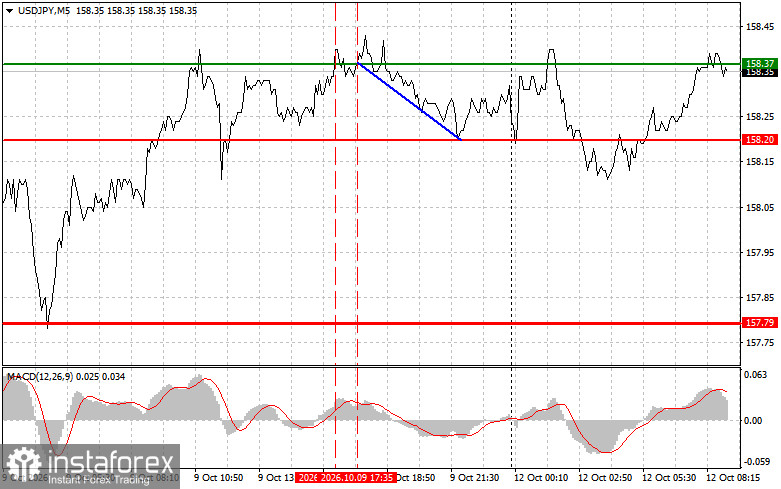
A price test at 158.37 occurred after the MACD indicator had already moved far above the zero line, limiting the pair's upside potential. For that reason, I did not buy the dollar. A second test of 158.37 triggered Scenario 2, prompting a sell, and the pair fell 17 pips.
USD/JPY begins the week fairly calmly. The University of Michigan data halted the dollar's rise but did not create serious downward pressure. For the yen, this is more of a neutral development than a reason to strengthen. The picture is as follows. The consumer-sentiment index fell to 46.3 in October from 48.1 in September and 53.6 a year ago. However, one-year inflation expectations rose to 4.7% from 4.6%, and long-term expectations rose to 3.5% from 3.4%, sustaining demand for the dollar. For the yen, policy divergence matters most. The market prices a Federal Reserve pause on October 28 and a rate hike on December 9 with roughly 80% probability, and that stance keeps dollar assets highly attractive. A pullback in yields after the 30-year auction and lower oil have slightly reduced dollar support, so the yen may briefly recoup some losses. However, I believe the dollar will remain near its year-high today, and USD/JPY corrections will be modest.
For the intraday strategy, I will mainly rely on Scenarios 1 and 2.
Scenario 1: Buy USD/JPY today near the 158.43 entry point (green line on the chart), targeting 158.63 (the thicker green line on the chart). Around 158.63, I plan to exit long positions and open short positions in the opposite direction (aiming for a 30–35 pip move from that level). It is best to return to buying the pair on corrections and serious pullbacks in USD/JPY. Important: before buying, make sure MACD is above zero and only beginning to rise from it.
Scenario 2: Also consider buying if price tests 158.30 twice while MACD is in the oversold area. That would limit downside potential and trigger a reversal upward. Expect moves to the opposite levels 158.43 and 158.63.
Scenario 1: Plan to sell USD/JPY only after a break below 158.30 (red line on the chart), which should lead to a swift decline. Sellers' key target is 158.12, where I plan to exit shorts and immediately open longs in the opposite direction (aiming for a 20–25 pip reversal from that level). Sellers can return at any moment—you only need a hint from the central bank. Important: before selling, ensure MACD is below zero and just beginning to decline.
Scenario 2: Also consider selling if price tests 158.43 twice while MACD is in the overbought area. That would limit upside potential and trigger a reversal downward. Expect declines toward the opposite levels of 158.30 and 158.12.
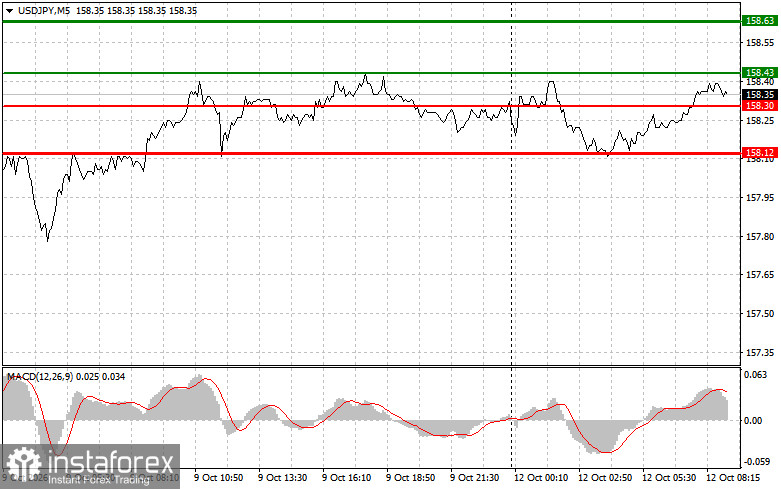
Thin green line — entry price where you can buy the instrument.
Thick green line — approximate price where you can place Take Profit or manually lock in profits, because further upside above this level is unlikely.
Thin red line — entry price where you can sell the instrument.
Thick red line — approximate price where you can place Take Profit or manually lock in profits, because further downside below this level is unlikely.
MACD indicator. When entering the market, it's important to consider overbought and oversold zones.
Important. Novice Forex traders must be very cautious when deciding to enter the market. It is best to stay out before major fundamental reports to avoid getting caught in sharp price swings. If you decide to trade during news releases, always place stop orders to minimize losses. Without stop orders, you can quickly lose your entire deposit, especially if you don't use money management and trade large volumes.
Remember: successful trading requires a clear trading plan, like the example above. Spontaneous trade decisions based solely on the immediate market situation are, by definition, a losing strategy for an intraday trader.
*Analiza tržišta koja se ovde nalazi namenjena je boljem razumevanju tržišta i ne pruža instrukcije za vršenje trgovanja.
Uz InstaSpot-ove analitičke preglede uvek ćete biti u toku sa tržišnim trendovima! Klijentima InstaSpot-a su dostupni mnogobrojni besplatni servisi za uspešno trgovanje.


