




Bitcoin trades near $77,240 as the market prepares for today's procedural vote on the CLARITY Act in the US Senate.
Yesterday, a bipartisan coalition of 18 state attorneys general and the District of Columbia, led by New York Attorney General Letitia James, sent a letter to the Senate Banking Committee urging changes to the bill before it moves forward. Notably, the coalition includes Republicans such as Chris Kobach of Kansas and Andy Wilson of Ohio, a rare example of cross party state officials uniting over the risks of federal preemption.

The prosecutors' objection focuses on one phrase in the bill's text — the definition of a "qualified transaction." In the coalition's view this wording would allow the Securities and Exchange Commission to override states' registration requirements for crypto transactions, effectively stripping state regulators of their enforcement tools. The attorneys general note that, since 2017, states have secured some 330 enforcement actions related to crypto fraud, and that Americans lost $11.4 billion to crypto scams in 2025, according to the FBI — a 22% increase year-on-year. Those figures are the cornerstone of their argument: state authority would be curtailed at a time when crypto fraud is rising, not falling.
A key nuance often missed in headlines is that today's vote is procedural — a cloture vote to end debate — not final passage. Cloture requires 60 votes and only determines whether the Senate will proceed to consideration of the bill. Even if cloture succeeds, the chamber will have only eight working days in September before the midterms to move the bill to a final vote. CLARITY passed the House in July last year and cleared the Senate Banking Committee in May. Its central aim — to allocate jurisdiction between the SEC and the CFTC across categories of digital assets — has been a long-standing industry priority in exchange for federal uniformity.
That is where the conflict of interest lies. The industry benefits from a single federal framework that replaces a patchwork of state rules, while states would lose part of an enforcement apparatus they have spent years building.
It is worth noting that, on the eve of the attorneys general's letter, President Trump agreed to accept much of a bipartisan ethics package from Senators Tom Tillis and Ruben Gallego that tightens conflicts-of-interest rules regarding crypto. A revised text, published Sunday evening, gives state attorneys general authority to enforce those ethics limits and sue exchanges that allow trading in assets banned by law. That concession was meant to reduce opposition, but the 18 attorneys general say it does not resolve the central problem of federal preemption of state registration authority.
Treasury Secretary Scott Bessent calls the bill "necessary" for US leadership in the global technology race and links it to the GENIUS Act on stablecoins. Meanwhile some banks have criticized revised stablecoin yield provisions, arguing they remain insufficiently workable. The political tug-of-war therefore spans both policy and industry constituencies.
My view is that even if the authors secure cloture today, the dispute over federal primacy versus state authority will not disappear; it will continue to shape debate as the bill moves along the process. For markets, that means opening debate will not end regulatory uncertainty but will move it to the next stage, where stakes for institutional players and exchanges operating across multiple states will rise.
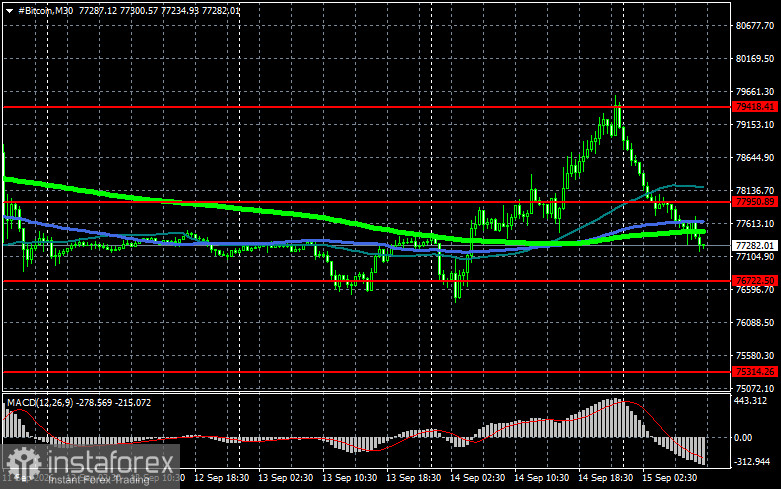
A technical picture for Bitcoin suggests that buyers are targeting a return to $77,900, which opens a direct path to $79,400 and then to $81,600; a break above that level would signal attempts to restore a bull market. On the downside expect buyers at $76,700. A move below that area could quickly drag BTC toward $75,300. A farther downside target is $72,800.
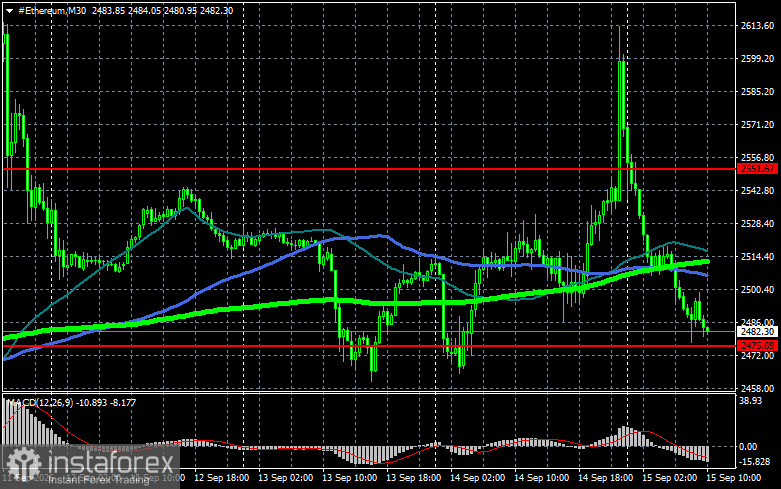
A technical picture for Ethereum involves a clear hold above $2,551 opens a direct path to $2,625. The farther target is the high near $2,684; a break above that level would indicate strengthening bullish sentiment and renewed buyer interest. On the downside expect buyers at $2,475; a drop below that area could push ETH toward $2,415. The farthest downside target is $2,367.
What we see on the chart:
- Red lines indicate support and resistance levels where either a price slowdown or active growth is expected;
- Green lines indicate the 50-day moving average;
- Blue lines indicate the 100-day moving average;
- Light green lines indicate the 200-day moving average.
A crossover, or a price test of moving averages, typically either halts the move or sparks fresh market momentum.
*A análise de mercado aqui postada destina-se a aumentar o seu conhecimento, mas não dar instruções para fazer uma negociação.
InstaSpot analytical reviews will make you fully aware of market trends! Being an InstaSpot client, you are provided with a large number of free services for efficient trading.