




Ons team heeft meer dan 7,000,000 handelaren!
Elke dag werken we samen om de handel te verbeteren. We behalen hoge resultaten en gaan verder.
Erkenning door miljoenen handelaren over de hele wereld is de beste waardering voor ons werk! U heeft uw keuze gemaakt en wij zullen er alles aan doen om aan uw verwachtingen te voldoen!
Wij zijn samen een geweldig team!
InstaSpot. Trots om voor je te werken!





Acteur, UFC 6-toernooikampioen en een echte held!
De man die zichzelf heeft gemaakt. De man die onze kant op gaat.
Het geheim achter het succes van Taktarov is een constante beweging naar het doel.
Onthul alle kanten van je talent!
Ontdekken, proberen, falen - maar nooit stoppen!
InstaSpot. Je succesverhaal begint hier!

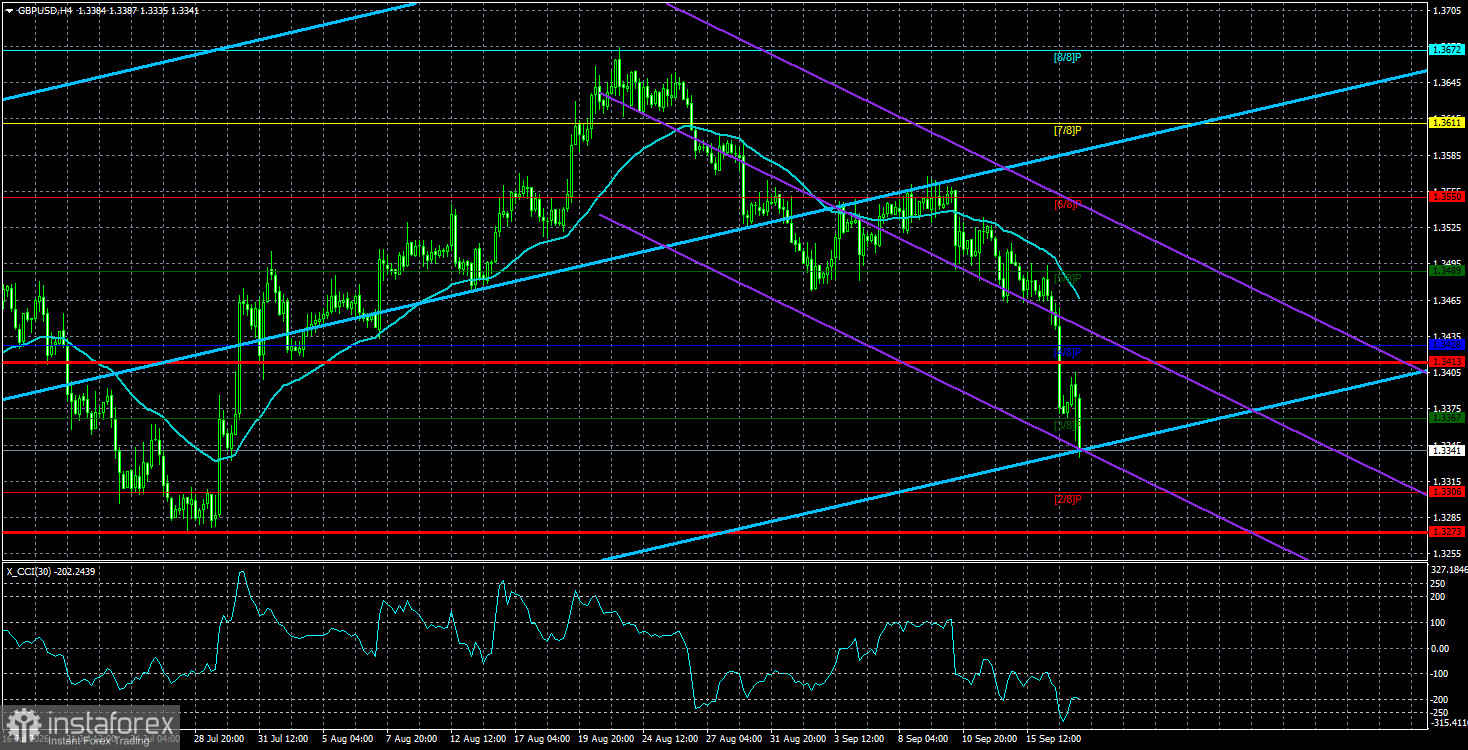
The GBP/USD pair collapsed for the second straight day on Thursday. If Wednesday evening's decline was driven by the Federal Reserve and its more hawkish stance than expected, then what drove Thursday's continuation? The Bank of England left the key rate unchanged, and only three MPC members voted to tighten — exactly as forecast. So why did sterling fall if the actual outcomes matched expectations? It appears there were no strong fundamental reasons.
Of course one can always say "the devil is in the details" and point to something dovish in the BoE statement — for example, that the BoE may not hike before year-end if inflation does not continue to accelerate. But the same could be said about the Fed: it could also refrain from further hikes if inflation does not move higher from the current 3.4%. Yet the market expects further tightening from the Fed, but not from the BoE.
Thus, as of Friday morning, we can only repeat what we said earlier: the dollar has no solid reasons to rally, and the market ignores many factors that work against the US currency. For example, what about US Treasury yields, which are making near-daily multi-decade highs? Rising yields increase the burden on the federal budget and add to the US government's already huge debt, which has surpassed $40 trillion. A new trade conflict between the US and Canada also offers little cause for celebration: new tariffs, new levies, new inflation.
The US economy still isn't growing at the rate Donald Trump promised, and the US labor market has averaged about 30k new jobs per month this year — not much more than last year. Geopolitics no longer reliably supports the dollar: the market has already adjusted to the Middle East war, the partial blockade of the Strait of Hormuz, and oil above $100/bbl with all its consequences. Therefore, we can identify only two positive factors for the dollar: Fed tightening and a possible Republican defeat in the midterms. The first factor has been priced in for the third or fourth time; the second is highly uncertain.
We think the dollar could react positively if Republicans lose control of one or both chambers of Congress. Americans associate many major policy changes with the Republican Party, so a Democratic win would not be surprising. If Democrats prevail, the US political system would regain a functioning opposition that could block questionable Trump initiatives — and that could be a modest positive for the dollar.
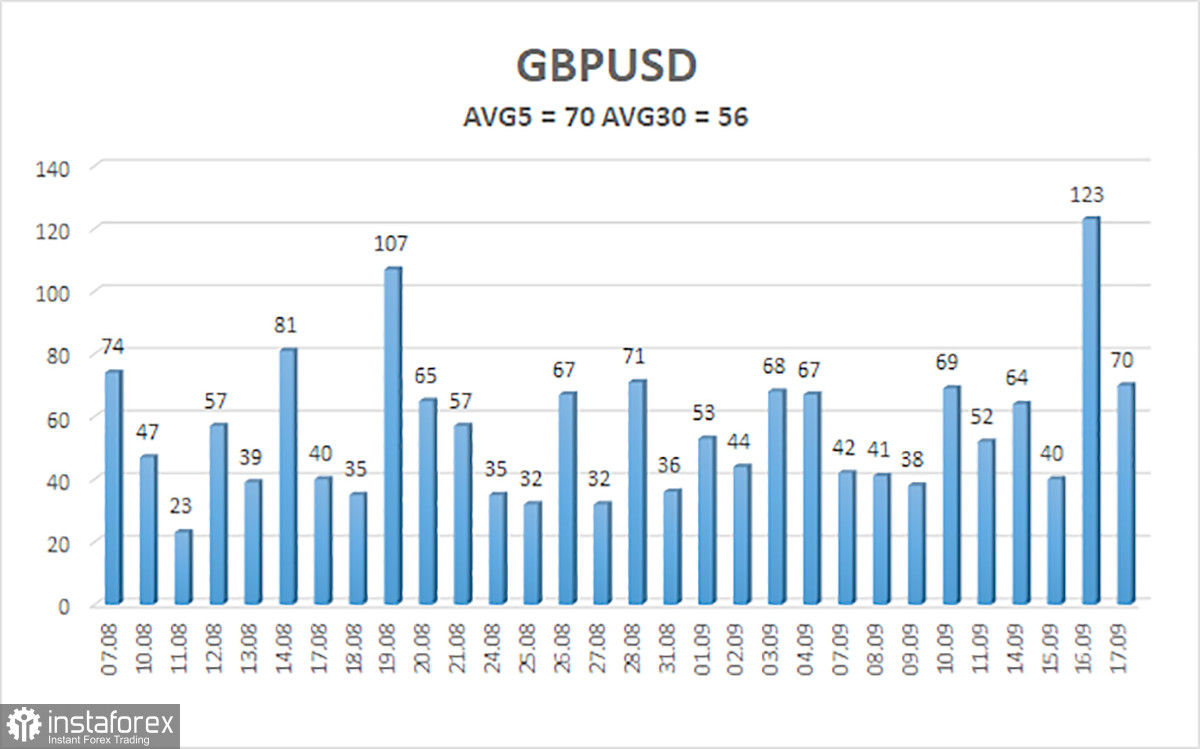
Average volatility of GBP/USD over the last 5 trading days is 70 pips, classified as "medium." For Friday, September 18, we therefore expect movement within the range 1.3273–1.3413. The longer linear-regression channel has turned up, indicating an uptrend. The CCI has entered the oversold area, warning of a possible end to the downtrend.
S1 – 1.3306
S2 – 1.3245
S3 – 1.3184
R1 – 1.3367
R2 – 1.3428
R3 – 1.3489
The GBP/USD pair maintains an uptrend. Trump's policies will continue to weigh on the US economy, so we do not expect long-term dollar strength. So far, 2026 has been positive for the dollar owing to geopolitics, but every story ends. On the weekly timeframe, a flat range persists between 1.3150 and 1.3780 within a four-year uptrend, which supports expectations for continued sterling appreciation in the medium term. Long positions with targets 1.3550 and 1.3611 can be considered while price stays above the moving average. Price below the moving average would justify bearish trading, with targets of 1.3306 and 1.3276.
Regression channels help determine the current trend. If both are directed in the same direction, it means the trend is currently strong;
The moving average line (settings 20,0, smoothed) defines the short-term trend and the direction in which trading should be conducted at present;
Murray levels are target levels for moves and corrections;
Volatility levels (red lines) are the probable price channel within which the pair will spend the next 24 hours based on current volatility indicators;
The CCI indicator – its entry into the oversold area (below -250) or the overbought area (above +250) indicates that a trend reversal in the opposite direction is approaching.
*The market analysis posted here is meant to increase your awareness, but not to give instructions to make a trade.
InstaSpot analytical reviews will make you fully aware of market trends! Being an InstaSpot client, you are provided with a large number of free services for efficient trading.


