




The legend in the InstaSpot team!
Legend! You think that's bombastic rhetoric? But how should we call a man, who became the first Asian to win the junior world chess championship at 18 and who became the first Indian Grandmaster at 19? That was the start of a hard path to the World Champion title for Viswanathan Anand, the man who became a part of history of chess forever. Now one more legend in the InstaSpot team!





Borussia is one of the most titled football clubs in Germany, which has repeatedly proved to fans: the spirit of competition and leadership will certainly lead to success. Trade in the same way that sports professionals play the game: confidently and actively. Keep a "pass" from Borussia FC and be in the lead with InstaSpot!

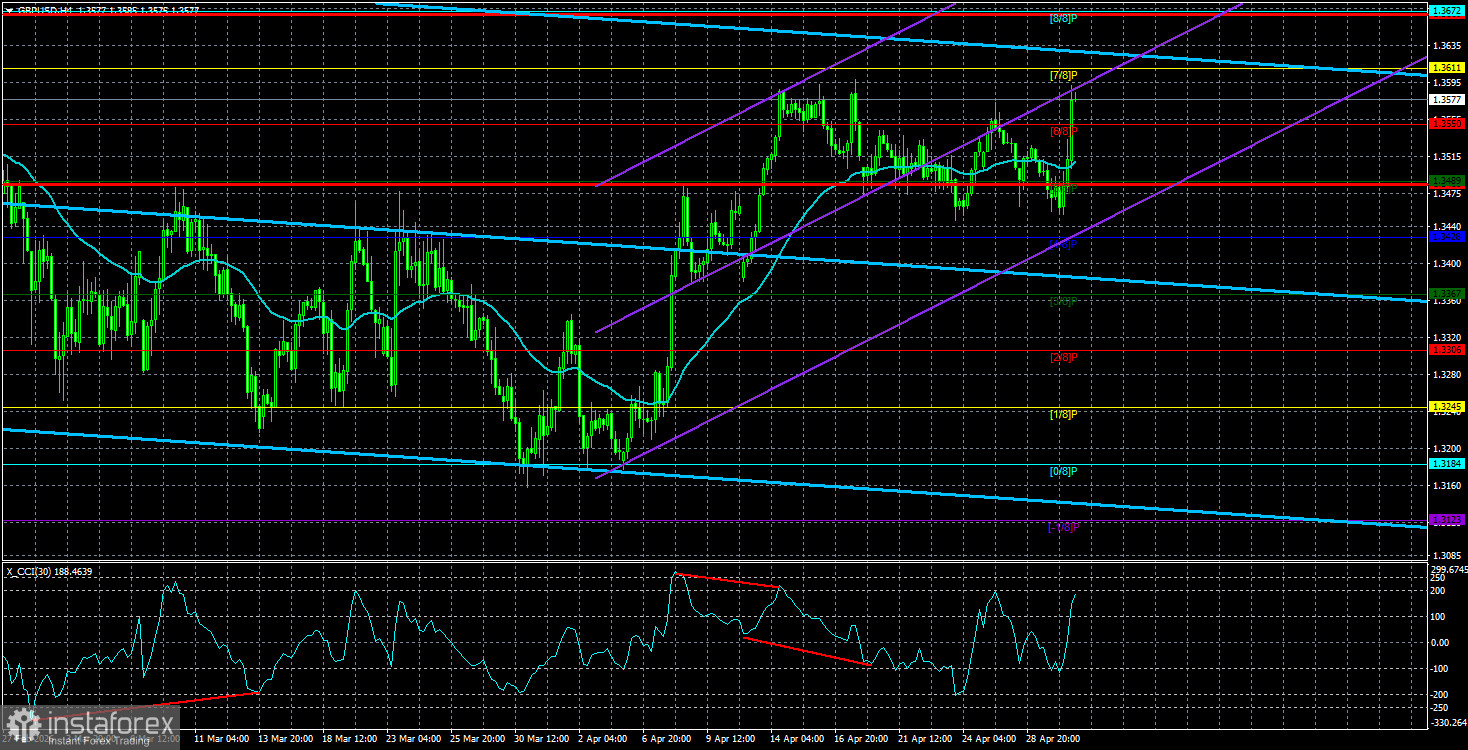
The GBP/USD currency pair continued trading within the sideways channel we discussed daily on Thursday, as shown on the hourly timeframe. Once again, the market ignored most events, but it could not overlook the Bank of England's meeting. The British central bank became the only driver for the market essentially on Wednesday and Thursday, which were filled with various events and reports.
So, what decision did the BoE make that led to a significant rise in the British pound? The most anticipated move was to keep the key rate unchanged. So why all the fuss? It was due to the Monetary Committee's voting results. Recall that the Monetary Policy Committee of the BoE consists of nine members. Until recently, the majority of policymakers supported further policy easing, as they believed inflation would return to 2% in the medium term. However, the war in Iran began, energy prices skyrocketed, and inflation followed suit.
By the way, British inflation showed the lowest acceleration as of March. At the same time, inflation in the U.S. and in the UK is currently at the same level, while it is much lower in the Eurozone. The problem is that there is no data on the voting of European Central Bank and Federal Reserve officials. The BoE publishes information about the results of the Monetary Committee's votes. This information triggered the rise of the British currency. It turned out that of the nine Monetary Committee members, only one voted for a rate hike. This voting result exactly matched the forecasts, raising the question: Why did the British pound rise?
The point is that at the previous meeting, not one of the BoE officials even considered tightening. And at the meeting prior to that, at least half of the officials voted for easing. Thus, it follows that the BoE's monetary policy vector has turned 180 degrees. As we know, the Fed has not signaled any possibility of a single tightening in 2026. However, the BoE now fully allows for such a scenario.
It can also be added that the BoE is not constrained by the labor market, and the UK government is not pressuring it. Imagine what would happen if the Fed decides to raise rates in the summer! Donald Trump might have a stroke, and Kevin Warsh could resign for failing to influence the Monetary Committee. Tightening U.S. monetary policy means the economy will slow further, and the labor market will contract further. Therefore, the BoE can afford to raise the key rate, while the Fed cannot. It is precisely due to this that the British currency appreciated on Thursday, pulling the euro higher with it. However, this rise will not be long-lasting. In our view, the British pound will rise in the medium term regardless of the policies of the Fed and the BoE. The geopolitical factor no longer supports the dollar, and there are no other grounds for the American currency's growth.
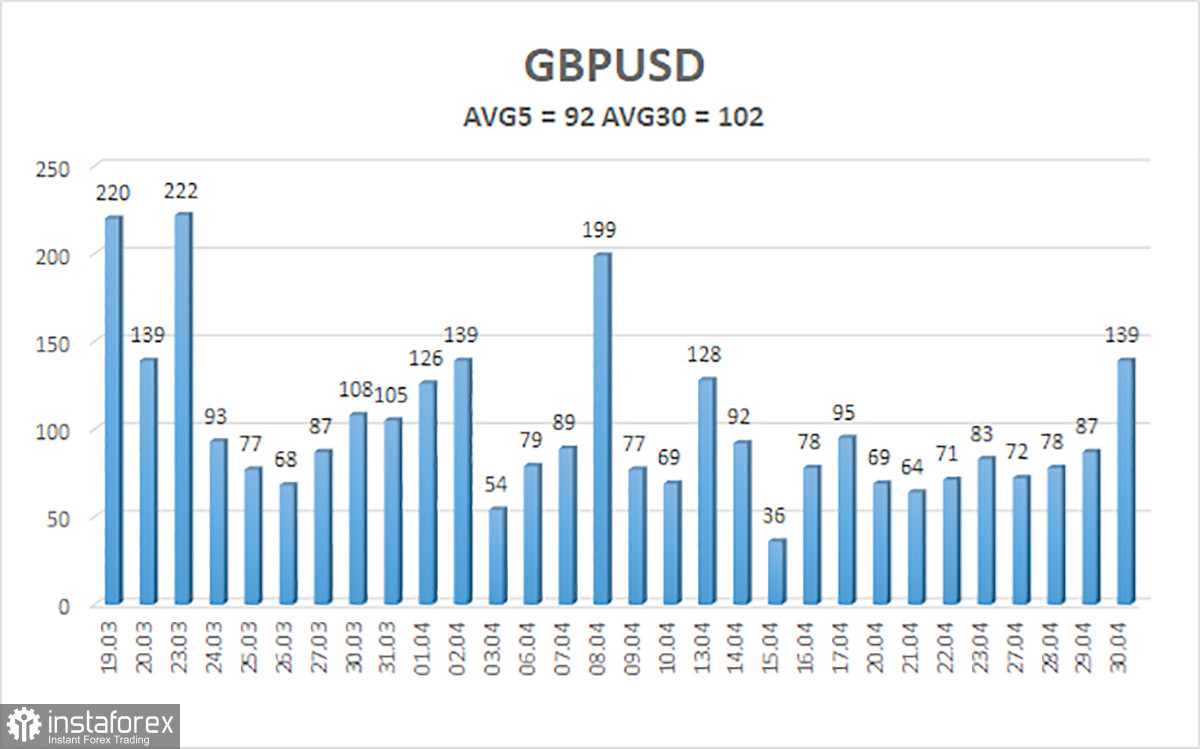
The average volatility of the GBP/USD pair over the last five trading days as of May 1 is 92 pips, which is considered "average." On Thursday, we expect the pair to move within a range defined by the levels of 1.3485 and 1.3669. The upper linear regression channel is pointing downward, indicating a downward trend. The CCI indicator has entered the overbought zone and formed a "bearish" divergence, signaling a potential downward pullback.
S1 – 1.3550
S2 – 1.3489
S3 – 1.3428
R1 – 1.3611
R2 – 1.3672
R3 – 1.3733
The GBP/USD currency pair continues to recover after two "months of geopolitics." Donald Trump's policies will continue to exert pressure on the U.S. economy, so we do not expect the U.S. currency to grow in 2026. Therefore, long positions targeting 1.3916 and above remain relevant while the price is above the moving average. If the price is below the moving average line, short positions can be considered with targets of 1.3428 and 1.3367 on technical grounds. In recent weeks, the British currency has recovered, and the influence of geopolitical factors on the market is diminishing.
*The market analysis posted here is meant to increase your awareness, but not to give instructions to make a trade.
InstaSpot analytical reviews will make you fully aware of market trends! Being an InstaSpot client, you are provided with a large number of free services for efficient trading.


