




Legenda v tíme InstaSpot!
Legenda! Myslíte si, že je to zveličovanie? Ako by ste však nazvali človeka, ktorý sa stal prvým Ázijcom čo vyhral ako 18-ročný juniorské Majstrovstvá sveta v šachu a ktorý sa stal prvým Indickým veľmajstrom vo veku 19 rokov? To bol začiatok náročnej cesty k titulu svetového šampióna pre Viswanathana Ananda, človeka, ktorý sa sa stal súčasťou histórie šachu už navždy. Teraz už ďalšou legendou v tíme spoločnosti InstaSpot!





Borussia patrí medzi kluby s najväčším počtom titulov v Nemecku a fanúšikom už viackrát dokázali svoje kvality ‒ súťaživého ducha a vodcovské schopnosti, ktoré ho zakaždým priviedli k úspechu. Obchodujte tak, ako súťažia profesionálni športovci: sebavedomo a aktívne. Zachyťte „prihrávku" od FC Borussia a napredujte so spoločnosťou InstaSpot!

The EUR/USD pair remains within a weak corrective pullback that cannot yet be considered complete. This week saw a number of important events, but it cannot be said that they made a strong impression on traders. The most significant events were the ECB and Fed meetings (unsurprisingly), but there were no decisions regarding changes in monetary policy. The ECB indicated that interest rates could be raised in the future (in summer), but this was already clear beforehand. Inflation in Europe has been accelerating for the second consecutive month—and quite rapidly. If the conflict in the Middle East continues for months and the Strait of Hormuz remains blocked, oil and gas prices will inevitably continue to rise. As a result, inflation will keep accelerating, forcing central banks to tighten monetary policy. At the same time, there is no progress in the vague negotiations between the United States and Iran, and according to some reports, Donald Trump is preparing new strikes. Thus, the euro's restrained growth this week may be replaced by renewed strength in the U.S. dollar.
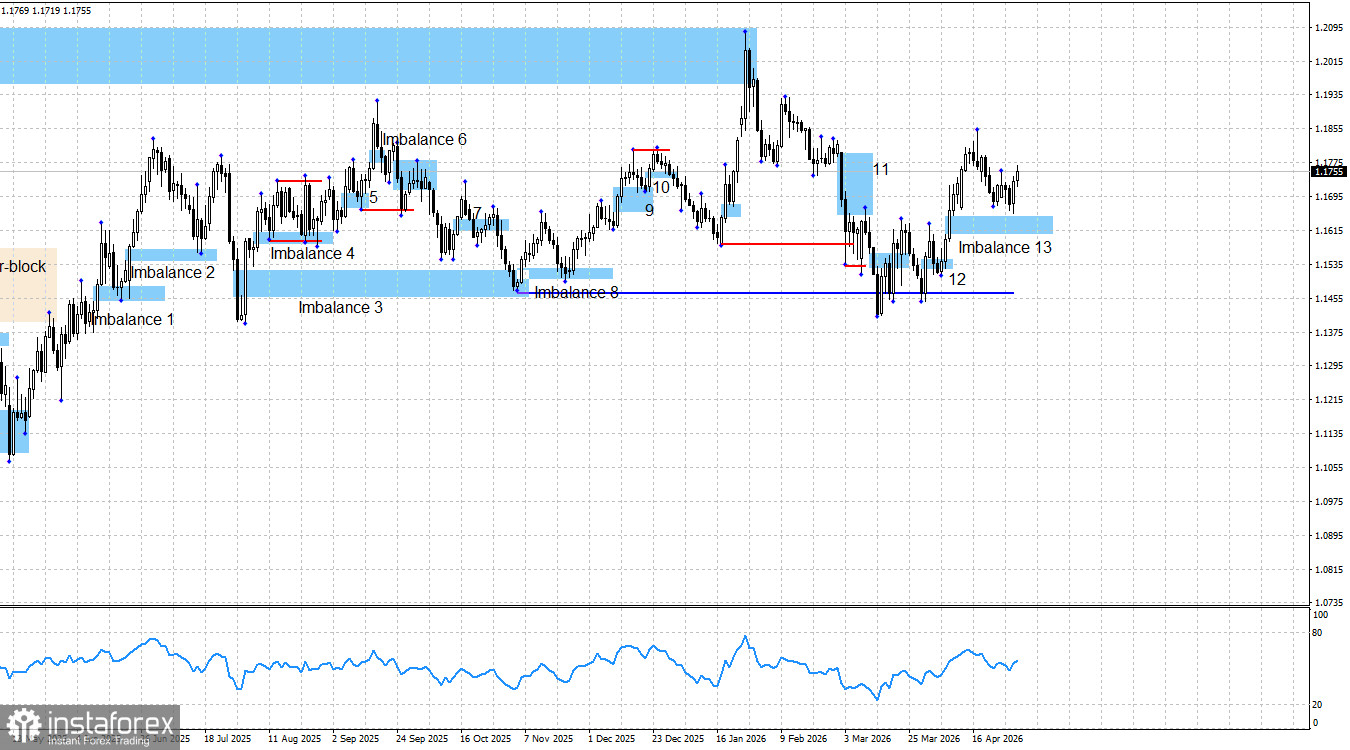
In the current situation, traders are left waiting for a reaction at imbalance 13. There are no other clear buying zones at the moment, and I still consider the trend to be bullish. Yesterday, bulls fell just short of reaching imbalance 13 and generating a signal. Notably, there are no bearish patterns at all, so there is currently no basis for selling the pair. The last buy signal at imbalance 12 worked very well, with the euro gaining about 270 points. Those trades could have been closed with solid profits.
It is worth noting that the entire rise of the U.S. dollar from January to March was driven solely by geopolitics. As soon as the U.S. and Iran agreed to a ceasefire, bears immediately retreated and bulls rushed in. At present, the truce remains fragile but intact. I have repeatedly stated that I do not believe the bullish trend has ended, despite the breakdown of important trend-forming lows. The movement over the past two months could evolve into a bearish trend if geopolitics continues to deteriorate. However, markets often price in the most pessimistic scenario in advance, trying to anticipate the most extreme outcomes. Therefore, it is possible that traders have already fully priced in the geopolitical conflict in the Middle East. For further bullish advances, the market currently lacks positive developments from the region, while for bearish moves, it lacks negative catalysts.
The overall chart structure is currently clear. First, the price showed no reaction to imbalance 11. Second, it reacted to imbalance 12, forming a bullish signal within a bullish trend. Third, a new bullish imbalance 13 has formed, which represents a zone of interest for future long trades as well as a support level for the euro.
The news background on Friday was practically absent. The U.S. ISM Manufacturing PMI had no impact. Bulls received minor support from the ECB's more hawkish stance compared to the Fed, but overall the situation remains unstable, mixed, and uncertain. The market largely ignored most economic data this week.
There are still plenty of reasons for bulls to attack in 2026, and even the outbreak of conflict in the Middle East has not reduced them. Structurally and globally, Trump's policies—which led to a significant decline in the dollar last year—have not changed. In the coming months, the U.S. currency may occasionally strengthen due to risk-off sentiment, but this would require continuous escalation in the Middle East. I still do not believe in a sustained bearish trend. The dollar has received temporary support, but what will drive bears in the long term?
Economic Calendar for the U.S. and the Eurozone:
On May 4, the economic calendar contains only two secondary events. The impact of the news background on market sentiment on Monday is expected to be negligible.
EUR/USD Forecast and Trading Advice:
In my view, the pair remains in the process of forming a bullish trend. The news background shifted sharply two months ago, but the trend cannot be considered canceled or completed. Therefore, bulls may well continue their advance in the near term, provided geopolitics does not suddenly escalate again.
Traders had the opportunity to open long positions based on the signal from imbalance 12, and the upward movement may continue toward the yearly highs. A new imbalance 13 has also formed, which could soon provide another bullish signal. For uninterrupted euro growth, the Middle East conflict would need to move toward a stable peace, which is not currently the case. However, bears also lack sufficient reasons to attack. In the near term, I would rely primarily on technical analysis, which points to continued bullish dominance.
*The market analysis posted here is meant to increase your awareness, but not to give instructions to make a trade.
InstaSpot analytical reviews will make you fully aware of market trends! Being an InstaSpot client, you are provided with a large number of free services for efficient trading.


